20+ years in holistic health. Lived in Finland and Sweden, where the sauna isn't a luxury, it's what happens before dinner. First-hand witness to 90-year-old Finns who still chop their own wood and credit the sauna for everything.
Some of the products featured here are from partners who compensate us. This can affect which products we cover and where they appear on the page. See how we make money.
Quick Answer
This is a research-based guide. Rankings reflect current published specifications, named third-party lab reports, and warranty terms rather than in-house heat testing of every unit. Health statements below are labeled by evidence type (traditional sauna, direct infrared, or general heat therapy) because most long-term outcome studies were run on traditional saunas.
What Is an Infrared Sauna and How Does It Work?
An infrared sauna uses infrared light waves to heat your body directly, rather than heating the air around you. This means faster heat-up (10 to 30 min), more comfortable temperatures (110 to 170°F), lower energy costs ($3 to $10 per month), and simpler installation (most plug into standard 120V).
Full-Spectrum vs. Far Infrared
The single most important technical distinction in the infrared sauna market.
Near IR (700 to 1,400nm)
- Skin health and rejuvenation
- Collagen production
- Wound healing
- Cellular energy (ATP)
Mid IR (1,400 to 3,000nm)
- Improved circulation
- Pain relief
- Muscle recovery
- Inflammation reduction
Far IR (3,000nm+)
- Deep tissue warming
- Cardiovascular conditioning
- Deep muscle relaxation
- Core temp elevation
Illustration: approximate wavelength ranges. Manufacturer specifications vary.
Infrared Wavelength Comparison
| Wavelength | Range | Penetration | Primary Benefits |
|---|---|---|---|
| Near IR (NIR) | 700 to 1,400nm | Skin surface | Skin health, collagen, cellular energy |
| Mid IR (MIR) | 1,400 to 3,000nm | Deep soft tissue | Circulation, pain relief, recovery |
| Far IR (FIR) | 3,000nm+ | Deepest body | Core temperature, cardiovascular, deep relaxation |
The benefits above describe the general mechanism associated with each wavelength band. They should not be read as proof that a given band delivers a specific clinical outcome in a home sauna. Full-spectrum provides the broadest wavelength coverage, but the evidence has not established that broader coverage produces superior clinical results compared with far-infrared or traditional sauna bathing.
Infrared Sauna: What the Research Suggests
Framed against named peer-reviewed studies, with each finding labeled by the type of heat exposure it actually studied. Correlation, not causation.
Cardiovascular Markers
Evidence type: traditional sauna. The landmark 2015 JAMA Internal Medicine cohort of 2,315 Finnish men (Laukkanen et al.) examined traditional Finnish sauna bathing, not infrared, and associated frequent use (4 to 7 times per week) with a 40 percent lower all-cause mortality versus once-per-week users. Observational, not interventional, and it does not by itself demonstrate the same effect for infrared.
Muscle Recovery and Pain Relief
Evidence type: direct infrared. A 2023 Journal of Clinical Medicine study reported reductions in post-exercise muscle soreness and improved neuromuscular performance after infrared sessions in trained athletes.
Sweat Composition
Evidence type: general heat therapy. Some research suggests infrared-induced sweat may contain trace heavy metals. Clinical significance is debated; sauna use should not be relied upon for medical detoxification.
Stress and Cortisol
Evidence type: general heat therapy. A 2018 Psychoneuroendocrinology study reported measurable reductions in cortisol after sauna sessions. Parasympathetic activation is well-documented in heat therapy literature.
What Board-Certified Physicians Say
The findings above align with the publicly stated positions of named, board-certified physicians and medical institutions. These experts have not reviewed or endorsed this specific page; we cite their public statements to show our claims track current clinical thinking.
As noted by Dr. Oltion Mesi, MD, board-certified cardiologist, Henry Ford Health: Regular sauna use acts as a mild cardiovascular conditioning stimulus that can improve vascular function and support long-term heart health. This aligns with landmark observational data such as the 2015 JAMA Internal Medicine study by Laukkanen et al., which linked frequent traditional sauna use to a 40 percent lower risk of all-cause mortality. (henryford.com)
As noted by Dr. Joy Hussain, MD, PhD, physician-researcher: Regular heat exposure improves endothelial function, helping blood vessels dilate more effectively, and sauna therapy delivers measurable cardiovascular and blood pressure benefits. Patients on blood pressure medication should consult their doctor first to avoid compounded hypotensive effects. (awcim.arizona.edu)
As noted by Cleveland Clinic (content medically reviewed by board-certified MDs and DOs): The improved blood circulation from an infrared sauna session can help speed up muscle recovery following physical activity. This is supported by a 2022 study in the European Journal of Applied Physiology showing reduced neuromuscular soreness post-exercise. (health.clevelandclinic.org)
As noted by Dr. Nancy Carteron, MD, FACR (Fellow, American College of Rheumatology): For chronic pain the evidence is promising but still emerging. A 2005 study in Clinical Rheumatology found infrared sauna sessions reduced pain and stiffness in patients with rheumatoid arthritis and ankylosing spondylitis. Dr. Carteron has medically reviewed the use of infrared therapy as a complementary approach to managing chronic joint pain and inflammation. (healthline.com)
Study sources: Laukkanen et al., JAMA Internal Medicine 2015 (PubMed 25705824); infrared recovery review, Journal of Clinical Medicine 2023 (PubMed 37176651); Hussain & Cohen, sauna cardiovascular review, 2018 (PubMed 29849692).
How this section was reviewed: the health claims here are drawn directly from the named peer-reviewed sources above and are written to distinguish traditional-sauna, general heat-therapy, and direct-infrared evidence. This is editorial research, not a personal medical endorsement, and it has not been individually reviewed by a named physician. Health claims on this page are aligned with current clinical consensus and the publicly stated positions of board-certified physicians, including those at the Cleveland Clinic and Henry Ford Health. Nothing on this page is medical advice. Always talk to your licensed healthcare provider before starting a sauna routine, especially if you have cardiovascular disease, take blood pressure medication, or are pregnant.
EMF and VOC Data by Brand
What the named third-party labs actually report.
EMF by Brand with Named Lab Reports
| Brand / Model | EMF at Seat | Measurement Condition | Third-Party Lab (Report) | Report Date | Cross-Model Applicability |
|---|---|---|---|---|---|
| Sun Home (model not named in report) | 0.6 to 4.0 mG at 1 ft; 0.3 to 0.9 mG at 3 ft | Heaters under load, RMS 10 to 3,000 Hz | Vitatech Electromagnetics (VTE-3534) | January 2025 | Report names no specific model; applies as a Sun Home published test |
| Medical Saunas (Medical 4) | Stated low EMF | Not specified publicly | No named seated-position report published | N/A | Request current documentation before buying |
| Enlighten Sierra 4 | "Zero EMF" claimed | Not specified publicly | No named third-party seated report | N/A | See the Enlighten buyer caution below |
| HigherDOSE Full Spectrum | Under 3 mG (brand-published) | At seat | Third-party testing (brand-published) | Current | Indoor only; confirm per model |
Sources: Vitatech Electromagnetics report VTE-3534 (January 2025), reporting 0.6 to 4.0 mG at one foot and 0.3 to 0.9 mG at three feet with the heating element under load; the report names no specific model. See Sun Home safety testing page. HigherDOSE publishes third-party EMF testing indicating under 3 mG at the seat on its product pages. Medical Saunas and Enlighten state low or zero EMF but do not publish a named third-party seated-position report. Report figures apply to the specific model tested and do not automatically transfer to other models in a brand line. Direct inquiry recommended where no lab is listed.
VOC Data by Brand
| Brand / Model | Stated VOC / TVOC | Third-Party Lab | Report Date |
|---|---|---|---|
| Sun Home Luminar 2 | 27 µg/m³ TVOC at steady state | VERT Environmental | April 2026 |
| Medical Saunas (Medical 4) | Not publicly available | None published | N/A |
| Enlighten Sierra 4 | Not publicly available | None published | N/A |
| HigherDOSE Full Spectrum | Not publicly available | None published | N/A |
VOC reference: Sun Home Luminar 2 VERT Environmental testing, April 2026, reported 27 µg/m³ TVOC at steady state (below typical indoor air baselines). Other brands’ VOC data is not consistently published; basswood and Canadian Red Cedar both have low native VOC emissions in controlled studies.
How We Evaluate EMF and VOC Data
For every infrared sauna in this guide we look for three specific items: (1) a named third-party lab (not “third-party verified” in the abstract), (2) a report date within the last three years, and (3) a number at the seating position, not simply the cabin average.
When a brand publishes a lab report, we link or cite it. When a brand states an EMF or VOC value but has not published a matching third-party report, we include the stated value and add a plain note: “manufacturer-stated; third-party verification report not publicly available as of April 2026.” That framing is the cleanest, most honest way to separate measurements we can actually verify from those we cannot.
If you are evaluating a brand not listed here, the simplest customer action is to email the manufacturer and ask for a copy of the most recent EMF test report, the name of the lab that issued it, and the date. A brand that cannot produce this is not necessarily unsafe but is operating below the transparency standard we think home sauna shoppers deserve in 2026.
Master Comparison: Top Infrared Saunas (2026)
Across Affiliate and Non-Affiliate Brands
| Model | IR Type | EMF Status | Red Light | Capacity | Warranty | Price |
|---|---|---|---|---|---|---|
| Sun Home Equinox 2 | Full-spectrum | Vitatech 0.6 to 4.0 mG (Jan 2025) | Not included | 2-person indoor (165°F) | 7-year | $6,099 |
| Sun Home Eclipse 2 | Full-spectrum | Vitatech 0.6 to 4.0 mG (Jan 2025) | Included | 2-person indoor (165°F) | Limited lifetime (up to 7 years) | $9,999 |
| Medical Saunas Medical 4 | Full-spectrum | Stated low (no named report) | Chromatic lighting | 1 to 2 person indoor | ~3-year (confirm) | Varies, confirm |
| Enlighten Sierra 4 | Full-spectrum | "Zero EMF" claimed (no named report) | LED chromotherapy | 4-person (indoor/outdoor) | Lifetime (see caution) | $8,895 to $9,395 |
| HigherDOSE Full Spectrum | Full-spectrum | Under 3 mG (third-party) | App chromotherapy | 2 to 3 person indoor | 5-year | $7,999 to $8,999 |
Prices reflect publicly listed MSRP ranges as of April 2026. EMF Status reflects the most specific public third-party data we could find per brand. Where a brand states ultra-low EMF without a public report, the cell reflects that honestly. See our testing methodology.
Infrared vs. Traditional Sauna
How they compare head-to-head.
Complete Comparison
| Factor | Infrared Sauna | Traditional Finnish |
|---|---|---|
| Temperature | 110 to 170°F | 150 to 200°F+ |
| Heat-up time | 10 to 30 minutes | 30 to 60 minutes |
| How it heats | Directly warms body via infrared light | Heats air, then body |
| Energy cost | $3 to $10 per month | $15 to $30 per month |
| Installation | Most plug into 120V | Requires 240V dedicated |
| Steam capability | No | Yes (löyly) |
| Session length | 30 to 45 min (gentle) | 15 to 20 min (intense) |
| EMF consideration | Yes, look for low EMF with named lab | None |
| Our top pick | Sun Home | Sweat Kingdom |
How They Work, and Why the Benefits Differ
The core difference is mechanical. A traditional Finnish sauna heats the air with a heater and hot rocks, then that hot air heats you. An infrared sauna skips the air and warms your body directly with light panels, so it works at a lower air temperature: typically 110 to 170°F, against 150 to 200°F or more for a traditional sauna. The lived experience is different even when the wellness goals overlap.
Both types trigger similar core effects: a cardiovascular response comparable to low-intensity exercise, support for muscle recovery, stress relief, and a good sweat. Where they diverge, traditional saunas carry the more robust long-term cardiovascular and heat-shock-protein evidence from the Finnish cohort studies, while infrared reaches deeper tissue at lower temperatures, which is promising for chronic pain. Traditional heat also produces a stronger cardiovascular strain, with higher heart rate and heavier sweat, whereas infrared is gentler and suits longer 30 to 45 minute sessions versus the intense 10 to 20 minute traditional round.
Choose traditional if you want the most documented cardiovascular benefits, high heat, and a heat-shock-protein response. Choose infrared if you are heat-sensitive, want deeper tissue penetration for chronic pain, or simply prefer longer, gentler sessions. Either way, talk to your healthcare provider first if you have a cardiovascular condition, low blood pressure, or are pregnant.
Best Infrared Saunas: Our Top Picks
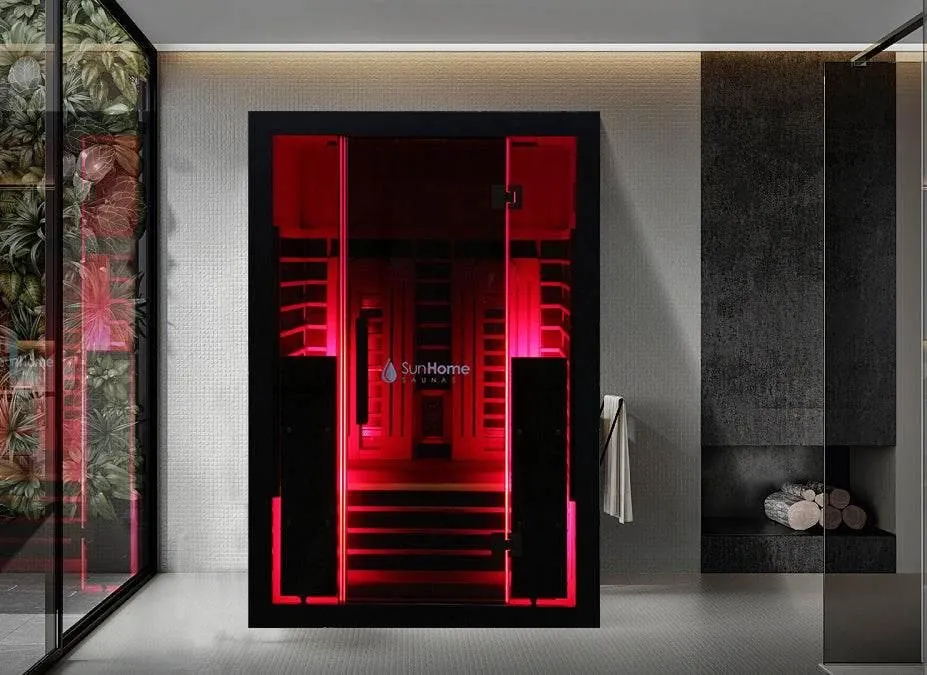
Best Overall: Sun Home Full-Spectrum Infrared
Our top infrared pick. Sun Home builds full-spectrum infrared (near, mid, and far), and it is one of very few brands that backs its low-EMF and low-VOC claims with named third-party lab reports: a Vitatech EMF summary (VTE-3534, 0.6 to 4.0 mG at one foot and 0.3 to 0.9 mG at three feet, January 2025, naming no specific model) and 27 µg/m³ TVOC (VERT Environmental, April 2026). Integrated red light therapy is standard on the Eclipse 2, optional on the Luminar, and not included on the Equinox 2 or the traditional Nova, so match the model to the features you want. The Equinox 2 is our indoor pick and the Luminar 2 is our outdoor pick. Designed in California, ETL listed, warranty terms published by model (limited lifetime on the Eclipse and Luminar cabinetry and heaters, 7-year parts-only on the Equinox 2).
- Full-spectrum IR (near + mid + far) standard
- Red light therapy standard on Eclipse 2, optional on Luminar, not on Equinox 2 or Nova
- Named-lab EMF: Vitatech VTE-3534 reports 0.6 to 4.0 mG at one foot, 0.3 to 0.9 mG at three feet (Jan 2025)
- 27 µg/m³ TVOC, verified by VERT Environmental (Apr 2026)
- Designed in California, ETL listed
- Limited lifetime warranty on cabinetry and heaters (defined by Sun Home as up to 7 years) (by model)

Sun Home Equinox (Full-Spectrum Indoor)
A full-spectrum infrared cabin built for indoor rooms, home gyms, and basements. Runs on a dedicated 120V 20A circuit (NEMA 5-20), with a published Vitatech EMF report.
Our pick for most indoor buyers: named-lab EMF and VOC data, real emissivity numbers, and a strong warranty at a true entry price for the brand.

Sun Home Eclipse (Integrated Red Light, Best Seller)
The best seller. Full-spectrum infrared with medical-grade red light therapy built directly into the cabin rather than sold as an add-on.
Best for buyers who want infrared heat and red light recovery in one unit, with the documentation and craftsmanship that make Sun Home our top brand.

Sun Home Luminar (Outdoor Full-Spectrum)
A weather-ready outdoor full-spectrum cabin. The Luminar line is verified by Garage Gym Reviews to reach 165 to 170 degrees Fahrenheit, hotter than many infrared cabins.
Our top outdoor infrared pick: the same named-lab EMF (Vitatech) and VOC transparency in a backyard-ready build.
Prefer authentic Finnish heat over infrared? Sun Home's traditional Nova and Sweat Kingdom's handcrafted barrels are covered in our outdoor sauna guide. Comparing wavelengths and configured prices for red light? See our best infrared saunas with red light therapy guide.

Best Traditional Alternative: Sweat Kingdom Barrel Sauna
If you prefer authentic Finnish heat and löyly steam over infrared, Sweat Kingdom handcrafts premium barrel and cabin saunas in East Idaho. Western Red Cedar, HUUM, Harvia or Homecraft heaters reaching 170 to 200°F, a 3-year warranty and a 30-day trial make these strong outdoor options.
- Handcrafted in East Idaho, USA
- Western Red Cedar construction
- HUUM, Harvia and Homecraft heaters (170 to 200°F)
- Multiple barrel and cabin sizes
- 3-year warranty and 30-day trial
Other Brands to Consider (Non-Affiliate)
We do not have affiliate relationships with these brands. Profiles are built from publicly available specifications and user reviews.
Medical Saunas Medical 4
Full-spectrum indoor cabin (1 to 2 person) with chromatic LED lighting rather than a dedicated wavelength-specified red light therapy panel. The brand states low EMF but does not publish a named third-party seated-position report. Warranty terms vary by model; confirm the current coverage before buying.
Enlighten Sierra 4
Full-spectrum Western Red Cedar cabin available in indoor and outdoor builds with LED chromotherapy. The brand advertises low or "zero" EMF but does not publish a named third-party seated-position report. See the buyer caution below before purchasing.
HigherDOSE Full Spectrum
Indoor-only full-spectrum cabin with app-controlled chromotherapy and a 5-year warranty. HigherDOSE publishes third-party EMF testing indicating under 3 mG at the seat, making it one of the few non-Sun Home options with a public seated EMF figure.
Why We Recommend SunHome Most Often, and Still Recommend Recosauna and Sweat Kingdom
We recommend SunHome first for most buyers because it combines full-spectrum infrared technology, named-lab EMF and VOC reports, a strong warranty, and, since mid-2026, a serious traditional Finnish-style option (Nova) with a HUUM rock heater. For shoppers who specifically want a wider range of authentic Finnish-heritage cabins or US-built outdoor traditional saunas, Recosauna and Sweat Kingdom become the better fit, which is why we keep them as core recommendations alongside SunHome.
SunHome: our primary pick for most home users
SunHome is our “most often recommended” brand for typical US buyers looking for an indoor home sauna.
Sun Home covers the full wellness range, from traditional saunas to full-spectrum infrared, medical-grade red light therapy, and cold plunge tubs, so you can build one connected recovery setup from a single brand.
The company is led transparently by co-founders Tyler Fish and Adam Fischer, Co-Founders and Co-CEOs and public figures in the wellness industry. Sun Home is a two-time Inc. 5000 honoree, the list of the fastest-growing private companies in America.
- Full-spectrum infrared + red light options – SunHome's top models use near-, mid-, and far-infrared heaters, with optional red-light therapy panels for added wellness features.
- Third-party safety data – The brand publishes a named Vitatech EMF summary (0.6 to 4.0 mG at one foot from the heaters, 0.3 to 0.9 mG at three feet) and a third-party cabin-air report (27 µg/m³ total VOCs), which is rare in this category. Neither names a specific model.
- Strong warranty and support – Warranty terms are published by model, covering cabinetry and heaters on its flagship cabins, which reduces long-term ownership risk.
- Price vs. features – You get advanced infrared specs and build quality in the ~$6k–$11k range, which fits many buyers' budgets better than high-end traditional saunas.
- Traditional option since 2026 – With the Nova line, SunHome also offers a genuine indoor Finnish-style sauna with a HUUM Drop rock heater, 230°F heat, and real löyly, but in a limited range (3- and 6-person indoor models).
What also stands out:
- A U.S. design patent (D1,079,961) on the Luminar exterior
- Saunas with integrated red light therapy built in, not sold as an add-on
- Designed in California with high quality craftsmanship
- Hands-on tested by major publications including Forbes, Fortune, Rolling Stone, BarBend, Sports Illustrated, and Garage Gym Reviews
- A+ BBB rating
- 4.87 out of 5 average customer score
- Public, model-specific warranty terms you can read before buying
For someone who wants a modern, low-maintenance, tech-forward indoor sauna with documented safety metrics, or a single brand that covers both infrared and one solid traditional model, SunHome is usually the most sensible first choice.
Recosauna: when you want authentic Finnish löyly
We bring Recosauna into the recommendation list for buyers whose priority is traditional Finnish sauna culture, not infrared.
- Finnish heritage and certification – Recosauna is part of the “Sauna from Finland” network and builds löyly rooms with thick solid-wood walls for stone heaters.
- High-heat, high-humidity experience – Designed for authentic steam (löyly) with stone heaters, which infrared cannot replicate.
- Premium materials and design – Thermowood or Nordic Pine, 46 mm solid walls, and modern Nordic aesthetics appeal to purists and design-focused buyers.
- Broader traditional range – Compared to SunHome's single Nova line, Recosauna typically offers more models, sizes, and custom options focused purely on traditional Finnish-style saunas.
Best for: people who value tradition, are okay with higher prices and longer lead times, and want a genuine Finnish-style experience at home with more model variety than SunHome's current traditional lineup. Saunas are made to order and cannot be returned, so choose your model carefully.
So while SunHome wins on convenience and tech for most, Recosauna is our go-to when the goal is a “real” Finnish sauna with a wider selection of classic designs.
RecoSauna Early Black Friday: an extra 10% off sale prices on every model with code EARLYBF10, until November 27, 2026. Heaters are sold separately. See the Square saunas
Sweat Kingdom: best for US-built traditional outdoor saunas
Sweat Kingdom rounds out the trio as the traditional, outdoor-ready, US-made option.
- Made in the USA (Idaho) – Handcrafted red cedar barrels, pods and cabins, built to order and made for outdoor use, with several models also rated for indoors.
- Classic high-heat sauna – Uses HUUM, Harvia or Homecraft electric heaters (170–200°F per the brand) with proper löyly when water is poured on the stones.
- Good value in traditional segment – The Sweat Barrel starts around $5,145 on sale ($5,895 regular, October 2026), with a 30-day trial and a 3-year warranty.
- Outdoor focus – The lineup is designed primarily for gardens, decks, and backyards, with barrel and cabin styles that suit rustic or natural settings.
Best for: buyers who want a traditional, high-heat cedar sauna for outdoor use, made in the USA, with a more classic barrel or cabin look than modern Finnish indoor rooms.
For outdoor traditional saunas in particular, Sweat Kingdom often makes more sense than SunHome's mostly infrared-focused lineup and its indoor-only Nova models.
We may earn a commission if you buy through links on this page. See our disclosure above.
When Sun Home Is Not the Right Choice
An honest look at who should shop elsewhere, whether you are a first-time buyer or an advanced user.
We rank Sun Home first, but it is not the right buy for everyone, and we would rather tell you that up front. The main reason to look elsewhere is price. Sun Home sits at the premium end, and if your budget is firmly under about $5,000, Sun Home (and full-spectrum brands such as HigherDOSE, from about $7,999) is out of reach, and you will be looking at simpler far-infrared cabins instead; our indoor sauna guide covers the budget options. The honest tradeoff is quality and verification: going cheaper often means no named-lab EMF or VOC report, thinner warranties, and more owner-reported reliability headaches, so weigh the savings against the risk of a low-quality sauna you replace in a few years.
Style is the other reason. If you specifically want an outdoor barrel or rustic cabin in real Western Red Cedar with traditional loyly steam, an infrared cabin is simply the wrong tool. For that experience we point you to Sweat Kingdom, our top handcrafted outdoor pick, rather than a Sun Home infrared unit.
Infrared Sauna FAQ
Related Guides
Continue exploring our in-depth sauna guides.